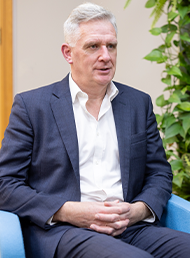
In this GCP Short, produced in partnership with Brown & Brown, Richard is joined by Mat Robinson, Senior Managing Director and Captive Operations Leader, and Matt Gravelin, Managing Director in Consulting at Brown & Brown, to discuss how organisations can hone their captive strategy and achieve strong internal buy-in from across the group.
Recorded at the VCIA annual conference, the trio explain what is involved in a captive strategic review, what parent companies are ultimately looking for from their captive and the value of socialising the captive internally.
Skuld Norway’s Bermuda-domiciled captive, Skuld Mutual Protection and Indemnity Association (Skuld Bermuda), was established nearly five decades ago as a contingency against geopolitical disruption.
As the risks facing the maritime industry have evolved, the captive has developed into a broader reinsurance platform supporting different parts of the marine carrier’s business.
Subscribe to Ci Premium to continue reading
Captive Intelligence provides high-value information, industry analysis, exclusive interviews and business intelligence tools to professionals in the captive insurance market.
I–RE has relaunched RE–PAID, refocusing on what I-RE says is an underserved mid-market of American businesses, paying up to $10m in premium, with five-year loss ratios below 40%.
Through RE–PAID, clients invest collateral into their own single parent captive and become their own reinsurer, taking on a limited amount of risk.
Subscribe to Ci Premium to continue reading
Captive Intelligence provides high-value information, industry analysis, exclusive interviews and business intelligence tools to professionals in the captive insurance market.
AM Best has affirmed the financial strength rating of A- (excellent) and the long-term issuer credit rating of “a” (excellent) of Oklahoma-domiciled OneNexus Oklahoma Captive Corp. (OneNexus). The outlook of these credit ratings is stable.
OneNexus is a property and casualty protected cell captive that was incorporated in 2021, and is managed by Strategic Risk Solutions, according to Ci Datahub.
Subscribe to Ci Premium to continue reading
Captive Intelligence provides high-value information, industry analysis, exclusive interviews and business intelligence tools to professionals in the captive insurance market.
Utah-based Grady Marshall has joined Captives.Insure as chief operating officer.
Marshall brings 16 years of brokerage and captive experience spanning single parent, group, and cell structures.
Subscribe to Ci Premium to continue reading
Captive Intelligence provides high-value information, industry analysis, exclusive interviews and business intelligence tools to professionals in the captive insurance market.
Jonathan Edwards, Partner, Head of Insurance and Risk, HCR Law
Captive Intelligence has covered the UK captive insurance developments extensively. Listen to our exclusive podcast episode with Paul Eaton and Martin Le Pelley, of Artex Risk Solutions, here, and read what the employee benefits community has made of the proposals here.
In another Thought Leadership analysis of the regulations Stephen Cross, of McGill & Partners, asks whether a ‘hidden ORSA’ undermines the competitive capital requirements that have been proposed, while you can find a wide-ranging feature carrying perspectives from across the market here.
Below, Jonathan Edwards, Partner and Head of Insurance and Risk at HCR Law, provides an assessment of the July 2026 consultation papers and their implications for corporate Britain, traditional insurance programmes and insurers.
In August 2025, we considered what an ambitious UK captive insurance framework would need to look like. The answer was a genuinely bespoke UK regime, benchmarked against established captive domiciles such as Bermuda, Guernsey and the Isle of Man, and built around four features:
Flexible underwriting
Proportionate regulation
Competitive taxation; and
Modern structures such as protected cell companies.
Twelve months later, the PRA has published CP11/26 and the FCA has published its companion consultation, CP26/29. Both consultations were published in July 2026, with responses due by 14 October 2026 and implementation expected in mid-2027. The question is whether the proposals deliver what the market was looking for.
On speed and regulatory burden, the proposals largely meet expectations. The proposed regime would treat UK captives as a separate type of insurer, with rules designed specifically for their lower risk business model, rather than applying the full commercial insurance regime. That matters because the PRA recognises that single-parent captives generally pose lower risks than commercial insurers, mainly because they insure risks within their own group or closely connected businesses.
The PRA and FCA are aiming for a 4-6 week decision period for complete applications. That is a major improvement on the current position, where a UK captive would otherwise be assessed through processes designed for standard insurers. It also brings the UK closer to the authorisation timelines seen in established captive domiciles.
The ongoing regulatory burden would also be lighter. UK captives would be supervised as Category 4 firms, the PRA’s lowest supervisory category, with supervision mainly driven by data, notifications and specific triggers rather than frequent firm-specific engagement. Reporting would be annual and simplified, based largely on statutory accounts. The PRA estimates that reporting frequency could fall by up to 80% and reporting volume by up to 75% compared with the existing baseline.
Capital requirements would also be materially reduced. The proposed captive capital requirement would be based on the higher of 10% of net written premiums or 10% of net insurance liabilities, subject to a £100,000 floor. Captives would also be able to use letters of credit and parental or group support arrangements as Tier 2 capital, subject to safeguards. That is a practical and commercially useful concession.
In short, the proposed regime makes a UK captive look workable. A business should be able to obtain approval more quickly, deal with less reporting and face lighter day-to-day supervision, while still operating within a credible UK regulatory framework. For UK groups, the attraction is more control over insurance costs, claims and harder to place risks, while remaining close to the London insurance market, UK regulators and UK professional advisers. On authorisation speed and day-to-day regulatory burden, the UK would move much closer to Guernsey and the Isle of Man than it is today, although it would not yet match them on PCCs, tax or market maturity.
On underwriting flexibility, the proposals are helpful but more limited. A UK captive would be able to write both direct insurance and reinsurance, which is a step forward. However, important restrictions remain. Compulsory lines, employee benefits and certain policies covering named individuals would be reinsurance-only. Life insurance, other than defined employee benefits, would not be permitted. Captives would also be restricted from writing some higher-risk or less suitable business, including investment risk protection.
The proposals are more flexible on some connected third-party risks. UK captives would be able to insure certain material non-group undertakings which include significant suppliers, franchisees, minority interests and owner-controlled insurance programmes, subject to safeguards. For most material non-group business, exposure would generally be capped at 10%, although owner-controlled insurance programmes would be treated differently. That goes further than some may have expected. But the first stage is still focused on single-parent captives. More complex programmes, especially those involving employee benefits, broader international risks or more varied third-party exposures may still find offshore domiciles more flexible for now.
The biggest structural gap is the absence of protected cell companies at launch. PCCs are widely used in leading captive domiciles and can help smaller or mid-sized businesses access captive insurance without setting up a full standalone insurer. Guernsey pioneered the PCC model and the Isle of Man also supports PCC structures.
The PRA and FCA intend to consult on PCCs later, once the necessary legislation is in place. That is sensible, but it means the UK will not launch with the full range of structures offered by some established offshore domiciles. This matters because PCCs can lower the cost and complexity of entry. Their absence at launch is therefore a competitive gap, particularly when compared with Guernsey.
Tax is the other major gap. The Government has said tax reform is not necessary to introduce a competitive UK captive framework and tax remains outside the PRA and FCA’s remit. However, tax is still a significant factor in domicile choice. That point cannot be ignored. Guernsey and the Isle of Man are both described as having favourable or competitive tax environments. Unless the UK can get close enough to offshore alternatives on tax, some groups will hesitate before relocating established captives.
The likely response from UK businesses will be measured rather than dramatic. FCA and PRA material suggests possible interest from 650-850 organisations, including 300-500 organisations with UK operations that already use offshore captives. An Airmic survey found that 58% of respondents would consider forming a new UK captive or relocating an existing captive to the UK. The PRA’s scenarios suggest that the UK might see up to around 20 new captive formations per year initially.
The more realistic outcome is a “test and compare” approach. New UK-focused single-parent captives may choose the UK, especially where board comfort, onshore governance, proximity to London and simpler regulatory engagement matter. Some existing captives may also consider moving, particularly where the benefits of being close to the parent group and the London market outweigh offshore advantages.
But mature or complex programmes are less likely to move quickly. Guernsey has more than 200 captives and remains Europe’s largest captive domicile, while Bermuda has more than 600 captives. Programmes that rely on PCCs, employee benefits, international risk coverage or specialist offshore market infrastructure are likely to wait for stage 2 and more clarity on tax.
Traditional insurance programmes are more likely to be reshaped than replaced. Captives can take on primary layers, retained risks, expensive or excluded risks and emerging risks such as cyber, ESG liability and supply-chain disruption. Commercial insurers will still be needed for fronting, reinsurance, excess layers, compulsory classes, employee benefits and multinational programme support. The likely result is a more layered insurance market. Captives will sit below or alongside conventional insurance, taking the risks that companies understand and want to retain. Commercial insurers will remain important where scale, licensing, compulsory insurance requirements, reinsurance capacity or international coordination are needed.
Insurers therefore face targeted pressure, not wholesale displacement. The FCA expects UK captives to increase the range of risk-financing options available to firms and to put pressure on conventional insurers to innovate. The areas most exposed are likely to be risks that corporates understand well and can model internally. The better response from insurers will be to support the captive model rather than resist it. That means providing fronting capacity, reinsurance above captive retentions, risk engineering, analytics, claims services and multinational programme support.
The July 2026 proposals are a credible first step. They deliver strongly on speed, proportionality and regulatory credibility. They make progress on underwriting flexibility, but they fall short on tax and broader structures. The result is likely to be gradual adoption rather than wholesale migration. UK businesses will test the regime, compare it with offshore options and decide programme by programme. Guernsey, the Isle of Man and Bermuda retain real advantages, especially on PCCs, tax, market depth and established infrastructure. But for the first time, the UK would offer a serious onshore alternative for straightforward single-parent captives.
Michael Parrish has joined Aon Guernsey as executive director.
Parrish joins Aon with more than 30 years of experience across captive insurance, alternative risk financing, risk management and insurance consulting.
Most recently, he served as senior vice president & client service leader at Marsh Management Services in Bermuda.
His career has also included senior roles across the UK, Europe and Asia Pacific.
Subscribe to Ci Premium to continue reading
Captive Intelligence provides high-value information, industry analysis, exclusive interviews and business intelligence tools to professionals in the captive insurance market.
Alberta is on course for another strong year of new captive formations, with the jurisdiction already licensing six captives this year, representing more than 13% of the total captives in the domicile.
Since introducing its captive statute in July 2023, Alberta has proved a popular destination for Canadian businesses, with the jurisdiction now hosting 45 captives.
Subscribe to Ci Premium to continue reading
Captive Intelligence provides high-value information, industry analysis, exclusive interviews and business intelligence tools to professionals in the captive insurance market.
The world is becoming increasingly uncertain, with conflicts, trade tensions, tariffs and disruption to critical trade routes creating new challenges for corporations doing business across borders.
Russia’s invasion of Ukraine has entered its fifth year with little sign that the war is nearing an end, while volatility and tensions remain heightened in the Middle East.
Subscribe to Ci Premium to continue reading
Captive Intelligence provides high-value information, industry analysis, exclusive interviews and business intelligence tools to professionals in the captive insurance market.